
Emily Kate Millerchip
PIPS Host Organisation: Wild Rain
PIPS Project Title: Baseline biodiversity assessments and community workshops at an example agroforestry farm, Akwamu-Kwanyarko, Ghana.
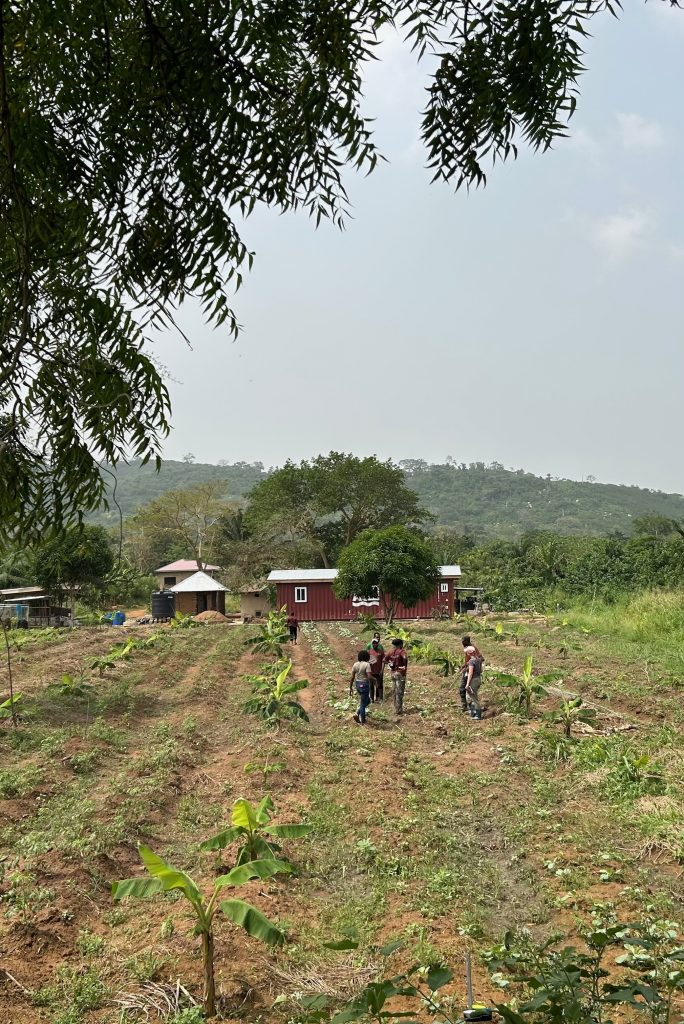
Wild Rain is an ecovillage based in Akwamu-Kwanyarko, Ghana, dedicated to transforming the food and farming landscape of the community through practical, grassroots solutions. The organisation leads a range of initiatives designed to promote sustainable agriculture and empower local people; including managing a model agroforestry farm that demonstrates how local farming can be both ecologically sustainable and highly productive.
Emily’s placement at Wild Rain combined ecological fieldwork with community engagement, providing hands-on experience in both research and outreach. During her placement, Emily designed and implemented an arthropod biodiversity monitoring protocol for the agroforestry farm and a comparison local conventional farm. This work involved setting traps, identifying insect species, conducting wildflower surveys and working with the farmers to collate local knowledge. In addition, she delivered several workshops for local farmers and schoolchildren, focusing on sustainability and the roles of biodiversity within agricultural systems.
Planning, organising, and carrying out this project over the course of the placement significantly strengthened Emily’s organisational skills and increased her independence. Working in a new environment, often with limited connectivity to resources, encouraged creative problem-solving and taught her how to prioritise key outcomes effectively. Through engagement with local farmers, schoolchildren, and university students, Emily developed her ability to communicate scientific ideas to a range of audiences, enhancing her science communication skills.
The opportunity to work in Ghana with Wild Rain, its sister organisation the Ghana Youth Environment Movement, and the University of Ghana also enabled Emily to build professional networks and gain insight into the interconnected roles involved in grassroots sustainability research. Living within this rural community gave her first-hand experience of the realities faced by smallholder farmers, including the social, ecological, and environmental challenges they navigate. This deepened her understanding of the global food system and strengthened her commitment to pursuing a career in this field.
Wild Rain shared very positive feedback about Emily, noting that she “travelled to Ghana for the first time in her life, immersing herself in the culture and delivering her research with minimal supervision” and that “her knowledge of biodiversity survey was impressive and her attitude on the field in a cross-cultural setting was really encouraging”. They added that Emily’s “openness to learn, interact and try new things was commendable.”